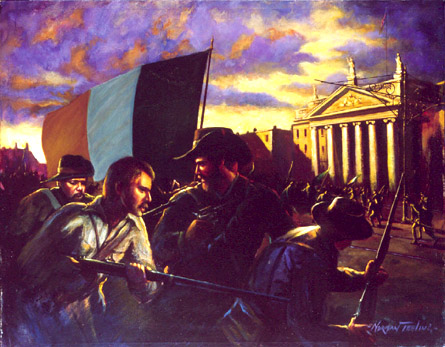
In 1995, An Post, Ireland’s postal service, commissioned artist Norman Teeling to create ten 36″ x 50″ oil-on-canvas paintings commemorating the Easter Rising of 1916. These striking works capture pivotal moments, such as Patrick Pearse proclaiming the Irish Republic outside the General Post Office (GPO) in Dublin, the heart of the rebellion. Displayed in the GPO’s main hall from 1996, the paintings celebrated the Rising’s legacy until the building was refurbished in 2005. Teeling’s vivid canvases remain a powerful tribute to Ireland’s fight for independence.
The GPO was designed in 1814 by Francis Johnston. Neo-classical in architecture, it is one of Dublin’s most imposing edifices. Scars from the gunfire can still be seen in the portico and on the Ionic order columns. The foyer is where the history of The 1916 Rising was displayed in an exquisitely researched sequence of paintings by Norman Teeling.computing-pay
The Signing of the Proclamation of the Irish Republic in Liberty Hall, Dublin. The signatories were Thomas J. Clarke, Sean MacDiarmada, P.H. Pearse, James Connolly, Thomas MacDonagh, Eamonn Ceannt and Joseph Plunkett.Freedom fighters outside the GPO, Dublin. Their aspirations not solely for freedom from British rule, but to create an Ireland where all people could be free to accomplish their potential, regardless of their wealth, class or religion.Patrick Henry Pearse – Pádraig Anraí Mac Piarais – Commander in Chief of all Republican forces in the field during The Easter Rising, read the Proclamation of the Irish Republic he authored from the steps of the GPO, Dublin.The Irish Republic flag is raised by a volunteer atop the GPO, Dublin.The beginning of the siege, showing the interior of the GPO, Dublin.Michael Collins returned from London to Ireland and served as aide to Joseph Plunkett in the GPO during Easter week. Afterwards he was interned at Frongoch, north Wales, released at Christmas 1916 and returned again to Ireland. Immediately he set about the rebuilding of the Irish Republican Brotherhood.James Connolly, commander of the Dublin forces, wounded, being comforted by his comrades at the GPO, Dublin. The words of the Proclamation which “Guarantee equal rights and equal opportunities to all citizens, civil and religious liberty” can be traced directly to the influence of Connolly.The burning of the GPO, Dublin. From Thursday 27th April the GPO was entirely cut off from other rebel garrisons. Next day it came under a ferocious artillery attack which also devastated much of central Dublin.The siege of the GPO, Dublin is ended. By Friday 28th April, the 1,600 rebels were facing 20,000 soldiers.With the assent of the leadership, Pádraig Pearse surrenders. Saturday 29th April, 1916. Having fought with discipline and skill, they surrendered their stronghold rather than fight to the last volunteer. Pearse would later be elected President of the Provisional Government of Ireland.
“Norman Teeling is as much a part of O’Connell Street now as the GPO.”
~ Veteran RTÉ broadcaster Joe Duffy
In 2015, Teeling had another go at commemorating The Rising, creating more than twenty canvases sized to fit more comfortably over a mantelpiece. These were featured in a very successful, centennial Easter Rising exhibition at The Oriel Gallery, Dublin.